

Share


Mike DeGeus, May 18, 2026
See What Upgrading to Cognos
12.1.3 Means for Your Environment.
Summary
Model Context Protocol (MCP) has crossed from experimental technology into enterprise infrastructure, with over 10,000 active public servers and adoption by every major AI vendor as of early 2026. For IBM Cognos and TM1 users, what MCP delivers today depends entirely on your platform. TM1’s comprehensive REST API enables rich conversational AI, running scenarios, writing data, and triggering processes through Claude. Cognos Analytics’ more limited REST API makes a custom SDK-based middleware approach the stronger path for deeper AI integration today. IBM’s ContextForge adds enterprise-grade governance and observability to MCP deployments but is still in early validation. Before any technical decision, the most valuable step is identifying which specific workflows you want AI to transform.
When the Model Context Protocol launched, I put it in the same mental category as a lot of early AI integrations: interesting experiment, worth watching, not ready to build on. That assessment has aged out. By early 2026, there are over 10,000 active public MCP servers and close to 100 million monthly SDK downloads. Every major AI vendor has adopted the standard. This is no longer something to track from the sidelines. It’s infrastructure.
Analytics leaders running Cognos or TM1 environments are asking the same question: what does this actually mean for us? The answer depends almost entirely on which platform you’re primarily running, and I want to give you an honest picture of why.
Table of Contents
Why Did MCP Grow So Fast?
The rise of MCP isn’t hard to explain. It correlates directly with the broader push by vendors to bring AI into the enterprise. Anthropic created the standard and has done the most to promote it, and given their focus on the enterprise space, that’s been a significant factor in MCP going from a niche interest to something that’s genuinely everywhere. Other major AI vendors followed because they needed a common way to connect their models to the tools and data that actually live inside organizations.
What’s different now versus a year ago is that the momentum has shifted beyond the AI vendors. Forrester is projecting that 30% of enterprise application vendors will launch MCP servers in 2026. The question for your BI environment isn’t whether your platform will have an MCP story. It’s whether you understand what your platform’s MCP story actually gives you.
What Does MCP Not Include Out of the Box?
Technical capability and enterprise utility are not the same thing. I’ve watched this play out across the AI space for a few years now. For personal use, AI is genuinely useful: you ask a question, you get an answer that’s probably better than what you’d find with significant research on your own. But in a business context, you need to actually rely on those answers. You’re not using AI just for summarization purposes or to help write emails. You’re building it into daily operations, into workflows where the answer matters and the audit trail matters.
Plain MCP makes integration easier, but it doesn’t automatically make integration production-ready. It’s not inherently insecure, but it’s also not inherently secure. Observability and standardization aren’t built in. These are gaps that organizations need to address before AI agents move from pilot projects to actual operations.
What IBM’s ContextForge is trying to do is close some of those gaps. Built on AWS infrastructure, it’s designed to bring everything together in a secure, managed environment: governance, observability, transparency across your agents. These are critical elements for enterprise adoption, and MCP on its own doesn’t provide them.
I want to be direct about where we are with ContextForge: it’s very new. We’re currently in the process of validating it, trying it out at some first sites, and I’ll know a lot more in the near future. We like what we see it bringing to the table. But I’d characterize it as an early-adopter play right now rather than a broadly proven production solution.
What Can You Do With a Cognos MCP Server Today?
I’ve built an MCP server for Cognos Analytics, so I can tell you what you’re actually working with. The Cognos REST API is limited. That’s not a knock on the platform; it’s just a fact about how it was built. The Cognos REST API is oriented primarily around administration of the environment: managing users, deploying content, configuring system settings. It’s not built around generating new analytics output or driving reports conversationally.
When you set up an MCP server on top of Cognos, that’s mostly what you’re going to get. You can automate administrative tasks through a conversation with Claude. That has some value, but it’s not the experience most people picture when they hear “AI agent connected to your BI platform.” You’re not asking your data questions and getting analysis back. You’re mostly moving things around in the environment.
IBM is building out the agentic story in Cognos 12.1.x, and getting onto the latest version is the right move if you want to access those capabilities as they arrive. But if you’re asking what MCP gives you with Cognos Analytics today, the API is the real constraint on the answer.
Why is TM1 Better Positioned for AI Agent Integration?
Planning Analytics and TM1 are in a genuinely different position, and this is where the picture gets interesting. TM1 has had a comprehensive REST API for a long time, and that changes what’s possible. The TM1 REST API covers nearly the full scope of what you’d do inside the application: reading and writing data, running TurboIntegrator processes, managing dimensions and cube structures. Set up an MCP server on top of that, and you have a large menu of actions that can be driven conversationally through an AI agent.
For TM1 environments, the sky is sort of the limit. Your planning team can explore their model, run scenarios, trigger processes, and do all of it through a conversation with Claude. The conversation becomes the interface. For organizations that have spent years building sophisticated TM1 models, this is a meaningful shift in how people can interact with that investment. The infrastructure is already there.
What Are Your Options As A Cognos Analytics Shop?
If you’re running Cognos Analytics without significant TM1 usage, you have more options than waiting on IBM to expand the REST API. The Cognos SDK exists, and for many of our clients it hasn’t seen a lot of recent use. By building a middleware layer on top of it and connecting that to a custom front end, you can build your own AI-connected solution. We’ve done this with clients and seen good results. It’s not a huge lift, and it opens up a lot of possibilities that a pure MCP-over-REST approach doesn’t give you.
The programmatic path into Cognos Analytics is real. It requires more custom work than the TM1 route, but it works today, and we’re certainly in a good position to help clients get there.
Where Should You Start With AI Agent Intregration?
Before making any specific technical move, the most important thing you can do is think through which use cases would actually move the needle for your organization. More so than any particular technical decision about MCP servers or ContextForge or API approaches, knowing what you want to accomplish is what determines whether any of this delivers value. What planning workflow? What data question? What interaction your team currently does manually that could be driven by a conversational agent instead?
The technology is ready, in different degrees depending on your platform. The question worth spending the most time on is what you’d do with it once you had it.
Questions I’m Hearing From Clients
The Cognos SDK path is real and it works. We’ve built middleware on top of it to connect Cognos environments to AI solutions, and the lift is manageable. It won’t be as clean as the TM1 route, but for organizations that want to start building now rather than waiting on IBM to expand the REST API, it’s a practical option. And the API story should improve as IBM continues rolling out agentic capabilities in 12.1.x, so you’re not necessarily waiting indefinitely.
I’d position it as an early-adopter opportunity. We’re actively validating it and we like what it brings to the table: the governance layer, the security, the observability. These are real things enterprises need. But it is brand new, and I don’t have a lot of field experience with it yet. For organizations that want to be ahead of this and can tolerate some first-mover friction, now is the time to engage with it. For organizations that need proven before they move, give it a few months.
MCP itself is protocol-neutral on security. It makes integration easier, but it doesn’t make it inherently secure or insecure. Whether an MCP-based integration is enterprise-ready depends on the governance and observability layer you build around it. That’s part of what IBM’s ContextForge is designed to address, though it’s still in early validation.
Yes, you can set up an MCP server for Cognos Analytics today. What you get is primarily administrative automation – managing users, deploying content, configuring settings. The Cognos REST API isn’t built around generating new reports or driving analytics conversationally, so the use cases are more limited than most people expect.
Plain MCP handles the connection. ContextForge adds the enterprise layer on top. If you’re running MCP in a production environment where the audit trail matters, those aren’t optional additions, they’re prerequisites.
We hope you found this article both intriguing and informative. At PMsquare, we specialize in cutting through the hype to deliver impactful, outcome-driven AI and analytics solutions. We help you build the data foundation, implement the right tools, and establish the governance needed to turn AI’s promise into your competitive advantage. If this is something you are looking for, contact us today.
Be sure to subscribe to our newsletter for more PMsquare updates and insights delivered straight to your inbox.
Make your Cognos data AI-ready
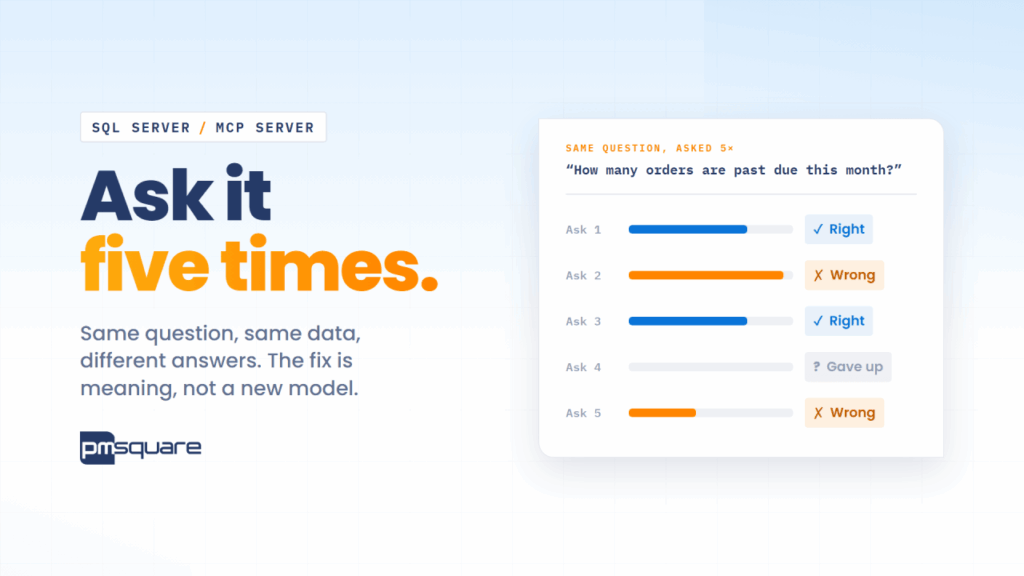
Ask an AI tool the same business question five times and you can get five different answers. Usually the model isn’t the problem. The data underneath it is, because the tables and columns don’t say what they mean. Your Cognos models already hold a lot of that meaning, so a lot of the groundwork may already be done.
Our AI Data Readiness site lets you watch this happen. A model answers one question five times against a raw schema. Then it answers five more times against the same schema with a plain-English description on every table and column, and you can see the answers tighten up. When you’re done, fill out the questionnaire and we’ll send you a free readiness report within one business day, reviewed by one of our consultants.